


CPULs when bad acronyms happen to good people
June 9, 2006
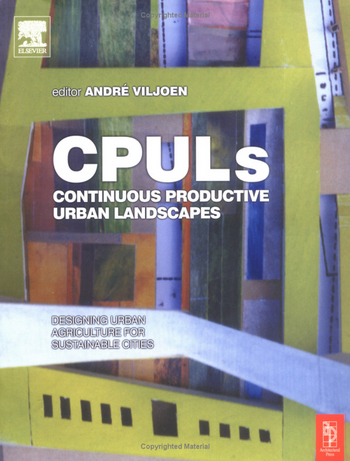
It’s pronounced ‘SEE, PULSE’ and stands for Continuous Productive Urban Landscapes. Architects Viljoen, Bohn and Howe’s positively radical notion of combining productive urban landscapes with continuous landscapes, proposes a new urban design strategy that would change the appearance of contemporary cities towards an unprecedented naturalism. Think urban agriculture, allotment gardens, increased biodiversity, decreased carbon emissions and strategically connected green space – and you will start to get an idea of what the authors are suggesting. Although this is in no way within the scope of the book, never have I encountered a more holistic approach to urban planning that so thoroughly takes into account our imminent plunge into energy descent and the extreme effect that this will have on our food supply.
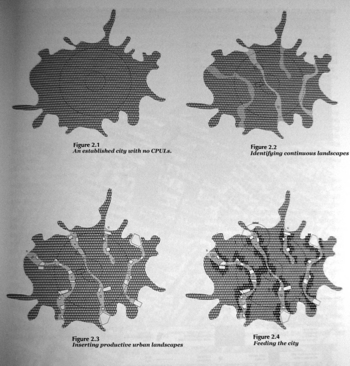
Diagrams showing a projected development of CPULs © Bohn & Viljoen Architects, reformatted for culiblog and used entirely with permission
Despite sporting a singularly unsexy title and a graphic design utterly devoid of charm, CPULs is a compelling vision for urban planners and (landscape) architects. The book is loaded with truly useful facts and case studies yet somehow remains a rivetting read for layfolk. The authors were wise enough to begin the book with a succinct glossary defining all of the concepts so that within five pages you’re already an adept at juggling terminology like vertical and horizontal intensification and you know the difference between an organiponico and a heurto intensivo.
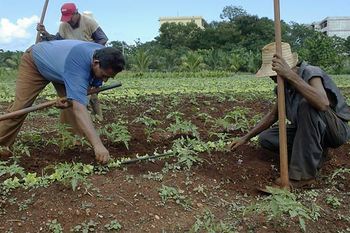
According to people who are in a position to compare, CPULs offers a rich documentation of UK allotment history and vivid reports of successful urban agriculture in contemporary Cuba, one of the few countries to have yet experienced peak oil. In 1990 when Cuba stopped receiving cheap juice from the Mothership and subsequently lost its largest client for agricultural produce, Havana citizens suddenly found themselves without access to sufficient food as expressed in 30% fewer calories in their diet! Instead of engaging in some futile rioting, they took up gardening en masse, and by gardening, I mean organic gardening. Later the government jumped on the bandwagon and started facilitating the urban agricultural effort in the form of responsible planning and infrastructure development. Presently Cuba is considered to be a living laboratory of how small urban farms and gardening collectives can successfully provide a significant portion of the urban food supply in spite of energy descent. Listen up, everybody! The CPULs authors were enlightened enough to note that a population accustomed to collectivism is more likely to be successful at community projects and that Northern European urban agricultural initiatives of the future will need to develop a native form to ensure their success.
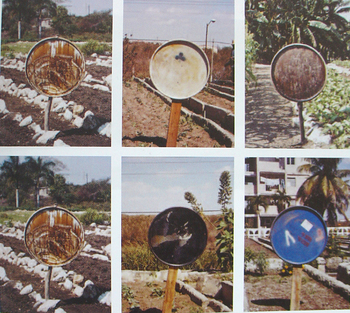
Oil drum lids used as markers in Havana organiponicos. Photos by Tom Phillips from CPULs used entirely with permission
CPULs’ authors articulate the benefits and obstacles to their proposal and offer cogent strategies for creating city land use policy in which urban green and brown are treated as productive space, considering the unbuilt as an event of equal intensity as the built. A vision of a thriving CPULs in London 2045 provides a powerful scenario that I can imagine myself being a part of at any stage in my life. This is something I would not characterise as a common feature in most urban planning. In CPULs city planning the well-being of people is a central and distinguishing factor. In fact, it’s completely seductive.
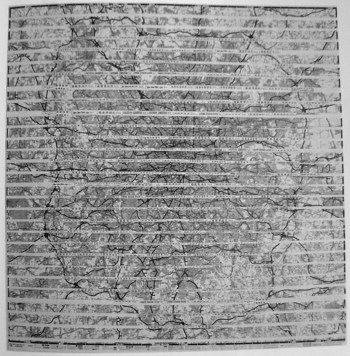
A map of London expanded to accomodate mini- and SUPER-market gardens, from a 1998 study © Viljoen and Bohn Architects, photographed from the book and used entirely with permission
Robert Hopkins from Transition Culture weblog notes, ‘It is only in the last 30 or so years that we have perfected the art of creating totally useless landscapes. New industrial estates and business parks typify this, planted with ‘low maintenance’ shrubs, specifically bred to be entirely unproductive.’ Bohn and Viljoen point out that though European cities have planned for a variety of approaches to open space including urban parks, urban river fronts, urban squares, urban stages, urban forests and urban beaches, there are as yet no urban fields. ‘Living and growing food in the contemporary urban space, CPULs could formally be similar to urban parks.’
I am inspired by the notion that landscape architecture could be pivotal in designing for a future in which peak oil will have tremendous impact on the urban food supply. As a massively independent researcher and writer on the subject of food and culture and as an artist/designer working with food in the public domain, and as an art and design educator, I cannot recommend this book highly enough. I hope that its concepts are embraced by those who are in a position to implement urban planning of this nature. The notion of CPULS deserves to feature prominently in design and architecture curricula, informing a new generation of people designing our cities and potentially our well-being through our access to healthy food.
CPULs do not yet exist.
In type, they will be new,
in type they will be productive.
See, pulse, with a silent meow at the end.
- Continuous Productive Urban Landscapes. Designing Urban Agriculture for Sustainable Cities. Andre Viljoen (ed) 2005. Architectural Press
- Biography of Andre Viljoen at the Royal Institute of British Architects website
- Robert Hopkins’ brilliant Transition Culture review of CPULs. The review also questions why Viljoen doesn’t use the term permaculture when the ideas in this book are so clearly informed by it. Hopkins points out that THIS book is exactly where permaculture needs to be. Although CPULs author Graeme Sherriff addresses permaculture rather thoroughly in Chapter 22 (Permaculture and Prodcutive Urban Landscapes) I can imagine that editor Viljoen felt a need for a new definition (and therefore produced that unfortunate acronym) because the notion of permaculture does not specifically address urban planning and land use policy.
- Permaculture according to Wikipedia
- Permaculture according to CPULs authors – quoting Robert Hopkins!: ‘Permaculture has evolved into a system for the conscious design of sustainable productive systems which integrate housing, people, plants, energy and water with sustainable financial and political structures.’ (Robert Hopkins, 2000, p.203)
- CPULs according to wikipedia. Oh how odd, there is as of yet no entry.
- Energy descent
- James Howard Kunstler, author of the Long Emergency
- Eat the suburbs – an Energy Descent Primer
- Some of the more positive aspects of peak oil:
Healthier food
More active lifestyles
Greater self-reliance
A sense of connection to place and products
The re-emergence of local identity
An emphasis on quality over quantity
A means of overcoming addictive behaviours such as over-consumption - Permaculture Activist, the magazine – excellent read!
- Energy Descent Primer
- An MP3 of permaculture ‘proponent’ David Holmgren lecturing on permaculture and peak oil
- Robert Newman’s History of Oil (stand-up comedy) on Google Video. Hilarious and not-so-hilarious at the same time.
debra at 13:51 | No comments | post to del.icio.us
Grow yer own dang biomass inadvertently
June 7, 2006
)
Way back in January, and then again in March, and again in April and May, I had big plans for my kitchen garden. Big and neat. Knowing that I would have to return from Occitania to the Polar Circle for gainful employment, I alphabetized my seed beds and planted sticks for beans and gourds to climb up and a rack for what I hoped would be groves of tomato plants, dripping with 4 sorts of fat tomatoes. I made a shockingly Dutch-looking irrigation system, so that when it came time to water, my neighbour Sidi ElGouche, could throw open the sluices and let er rip. And Sidi ElGouche being the sweetheart that he is, was not shy about making sure that in my absence, my kitchen garden got a goodly amount of water.
When I returned to my garden on the 14th, I encountered a solid plot of homegrown biomass.
.'))
debra at 15:06 | No comments | post to del.icio.us
Here as the Centre of the World, in terms of food
June 3, 2006
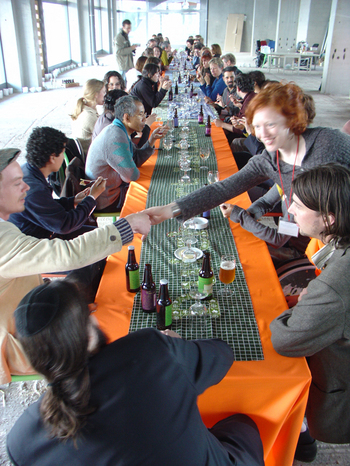
Here as the Centre of the World banquet with local food from Twente and Overijssel. Guests getting giggly on the bubbly.
A week and a half ago, my colleagues and I at the Dutch Art Institute (DAI), were in the throes of an international symposium on ‘all things periferal’ for artists and mediators. Illustrious guests from Overijssel and the ‘rest of the world’ were invited to discuss this (contemporary art) subject for two solid days in the Rijksmuseum Twenthe. Early in planning phase of this event, I decided that the symposium would be more coherent if, during the the event, we attempted to eat food grown and produced from within the province, a Twente tasting menu. In a huge gesture of over-confidence, I took upon myself the task of organising the symposium’s food side, in particular a sit-down banquet for fifty, on the 23rd of May. All of the food for the banquet and incidental feedings would come from within the province of Overijssel, within a 60 kilometre radius of the event epicentre.
- Here as the Centre of the World Banquet Menu
- fork -local pickled beet with smoked herring, and strips of rhubarb
spoon – turnip green mash with goat cheese
knife – lumps of bread - Kruudmoes:
- Hangop served with caramel sauce and berry coulis
- Wines
- Meibok, Witbier, Vrouwe van gramsbergen and Blond beers
barley, buttermilk and fatback porridge served with ground up local greens including: ground elder (zevenblad), white deadnettle (dovenetel), kohlrabi leaves, applemint, spearmint, peppermint, curly leaf parsley, beet greens, spinach, sorrel and ‘Roman’ chervil
from the Hof van Twente Winery
from the Mommeriete Brewery
debra at 14:35 | No comments | post to del.icio.us


