

City Food
wild and edible
June 29, 2005
)
image courtesy Marjolijn Dijkman
It’s not an urban myth, edible food is growing wild in the city. In the Basel street where the artist initiative Filiale is located there are a myriad of little green grocers, representing just as many nationalities of people that populate the neighbourhood. Dijkman, de Jong and Herzog collected edible plants growing wild within the city of Basel, uprooted them, replanted them in pots and offered them for free in their City Food shop in the garage of Filiale. ‘Here, locally grown food, for free!’
This act was an investigation by the artists into the ‘natural resources’ of the city, and of the audience’s knowledge and perception of their under-the-radar local food supply. Very few visitors took home the plants that the artists had to offer. Some took offense, believing that the installation was a sarcastic joke about what is ‘local’. Many visitors, primarily those originally from abroad, were exceptionally knowledgeable about the edible treasures growing in and around Basel. Neighbours from West Africa began to explain the nutritive and medicinal attributes of the City Food assortment. An Italian neighbour recounted how in his home town, cooks often nip outside the kitchen to rush up a hillside and rip up some fresh herbs or leafy greens slash weeds to add to their soups and salads.
)
image courtesy Marjolijn Dijkman
Some of the visitors complained about the artists’ lack of knowledge about the local flora. Others were disappointed when they entered the ‘shop’ looking to buy food only to discover that all that was on offer was food they would ultimately have to grow themselves. That’s a lot of work for just a tiny heap of salad, especially when the greens look feeble in comparison to everything on offer at the other shops on the street.
City Food took place amidst a political climate in Switzerland in which a strong but vocal minority was attempting a ban on food imports in order to encourage Swiss farmers and their products. Sounds healthy? Sounds Right, right? The City Food project addressed the notion of ‘local’. But what is an indigenous plant and what is a weed? And who is local, and who will be considered forever a foreign element?
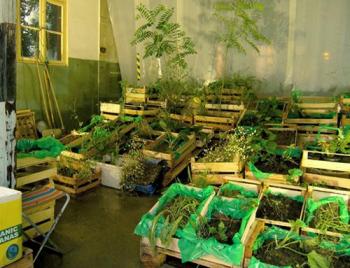
image courtesy Marjolijn Dijkman
City Food, M.Dijkman, A. de Jong, D. Herzog
Basel Switzerland, 2005
debra at 16:05 | Comments (0) | post to del.icio.us
Lolly Lab
June 28, 2005
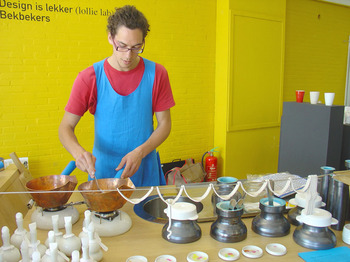
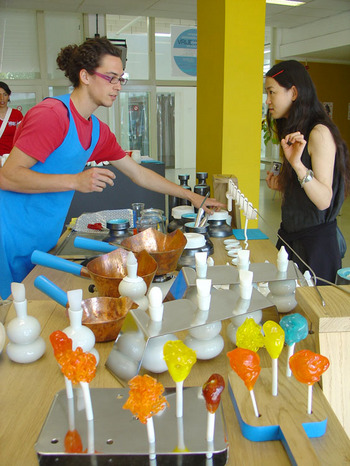
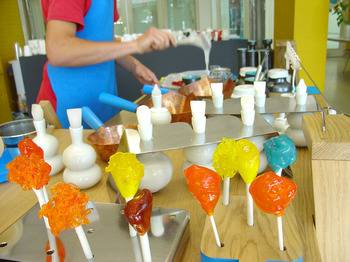
Imagine my delight last Sunday when the very first work I see at Arnhem’s exam show is Bas Kools’ Lolly Lab. Kools is a freshly graduated designer with fine prospects for the future. He’ll attend the RCA in London next year.
What I loved most about Kools’ setup was that he put the prototypes into a playful context. He seemed to have thought of everything; the playful array of lolly sticks, sugar melting copper pans, ceramic pots and recepticals, the vessels containing the flavours and colours, palet dishes, a working lab unit with gas burners (water?), air blowers, lolly holders in metal and rubber, bottle stops, display, etc… Kools has an interest in finding ways to make ‘design’ ‘accessible’. But some of the sexier shapes of the lolly holders and the rubber slings reminded me immediately of the details hidden (and thus showcased) in a Matthew Barney work. Not bad.
And this leads me to my wee critique of the work. Kools designed a lolly laboratory, a perfect context for his range, so where are the experimental lollies? It is a pity that in this instance, Bas used standard flavours, colours and non-designed shapes for the lollies themselves. It would be worthwhile investigating working with a chef or someone with a developed and outspoken culinary aesthetic to create flavours, colours, textures and shapes as alluring and expressive as the other parts of this lab and installation. The well-designed utensils, if they are meant to be accessible, should serve and even contribute to the experimentation that is going on in the lab. There is still plenty of space for this to happen in the future. I certainly would be willing to give it a go; the Lolly Lab gave me itchy fingers.
(Please read more… )
debra at 10:21 | Comments (4) | post to del.icio.us
I would have been satisfied with less
June 27, 2005
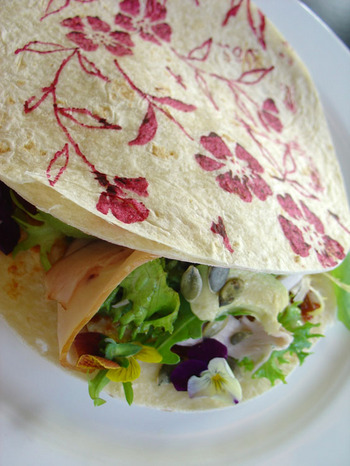
Café Dudok in Arnhem prepared a special menu in honour of the Arnhem Fashion Biennale. Dutch Art Institute student, MuXue and I were visiting Arnhem for other reasons entirely but we did manage to end the day with an hors d’oeuvre and dessert at said café. The starter, a smoked turkey avocado and edible flower ‘wrap’, was printed in a floral pattern with cherry red pigment. It was most unfortunate that the pigment had no additional flavour because it would’ve been great if the pattern was made out of salsa picante for example, with an overlay of patterned guacamole and maybe cutout smoked turkey in pretty tailored shapes. Bring on les ruches!
Also the California-Dutch in me always feels inclined to let folks know that ‘wraps’ (let’s just call them white flour tortillas from now on) really should be served warmed up to arouse the subtle flavours of the nutritional void that is white flour.
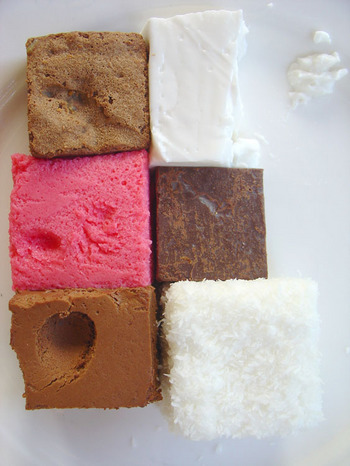
The dessert of this fashion menu was presented rather simply and therefore I reacted to the lack of pretension with less venom. Visually it reminded me of Allsorts licorice candy. It was a dessert of blocks and a worthwhile array of textures, had some of the flavours not come from directly out of standard bottled essences. MuXue and I felt we were served far too much food, but that’s something that seems to be inescapable these days. The service was great by the way, and this is a rarity in a café in the Netherlands.
Squares from top left and top to bottom: walnut fudge brownie, bitter almond pannacotta, raspberry bavarois, dark chocolate-raisin fudge, cake au mousse au chocolat, coconut snowball. The finger pokes in the mousse and in the raspberry bavarois are the author’s own.
(Please read more… )
debra at 6:46 | Comments (4) | post to del.icio.us


