



My cover cropslash green manureexperiment is a success
May 3, 2006
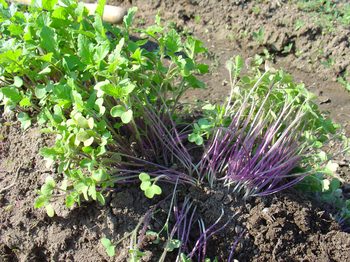
Mustard microgreens, about to be turned into green manure
This January in an experiment in producing biomass, maintaining good soil condition and weed mitigatation in my lower garden, I planted green manure cover crops. Of course nothing sprouted because in January the ground is far too cold and you’d have to be a crazy woman who has just read fifteen articles about the benefits of green manures to do such a thing. But in March I re-sowed the same crops again and this time the seeds sprouted to the acronym AMBRASSS, rhymes with je t’embrace, alfalfa, mustard, buckwheat, red night kidney, adzuki, soy, soy, soy).
This lower garder is going to be my workaday garden for plants that take up space, need verticality and like to roam. Yesterday I turned the alfalfa, mustard and buckwheat rows under as green manure for the summer’s seed beds. I am thrilled to bits with the results of the covercrop/green manure experiment. The plants yielded very long roots and massive hairy rootballs, all of which are going to rot forthwith and produce a healthy subterranean microbial culture upon which the summer gourds and melons will thrive. Whilst turning the soil I came across zillions of earthworms, dark and fat. Am I insane for not really liking the rototiller, turquoise though she is?
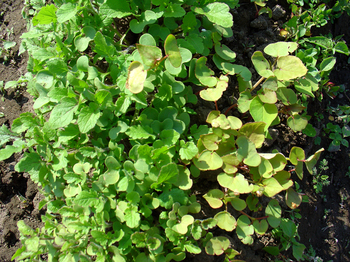
Mustard and buckwheat, sadly no image of the alfalfa
The goal of the first phase of this experiment (produce biomass to introduce organic material into the soil) is an absolute success. The goal of the second phase of this experiment is to see how the green manure performs. Performs in comparison to what, is the question.
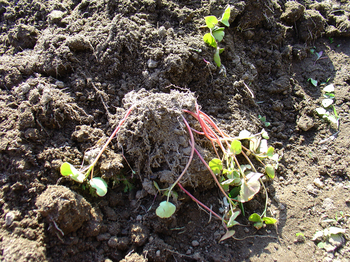
A clump of buckwheat showing how much rootmass it has produced, pretty red-stemmed and bronze coloured foliage
Reality check: It probably goes without saying that I have not exactly applied the scientific method to this ‘experiment’ and should probably call it the ‘Hmm, wonder if this works’ method. Unfortunately I’m emotionally attached to the green manures and cover crops concept and have already decided to get good at doing things this way, but I’ve observed (unfortch) that the array of native ‘weeds’ in combination seem to produce as much biomass as the alfalfa, mustard and buckwheat mix, although I don’t know what they do to the soil condition. Considering that the soil condition already looked good before starting, I have no reason to believe that the weeds deplete the nutrients, but of course I’ll never know because I didn’t leave a control section.
And obviously, because I can even write about the native weeds shows that the covercrops weren’t really that good at mitigating weeds – although there were LESS weeds in the rows than on the banks of the rows. I’m more of an eyeballer than a counter.
Come autumn, the proper season for planting the green manures, I’ll try planting over the entire allottment to see if this helps with weed mitigation. In fact, I’ve pretty much decided that throughout the summer I’m just going to go around throwing alfalfa, mustard and buckwheat seeds at everything.
Whatevs. I’m married to the idea that these plants will be my new weeds and I even had a dream last night that after years of planting the cover crops, I had increased the biomass on my allottments so much that my gardens were one metre higher than everyone elses.
debra at 11:05 | Comments (2) | post to del.icio.us
Kitchen garden before Ice Saints
May 2, 2006
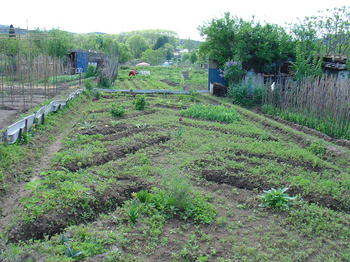
My kitchen garden on the 27th of April
Some people grow up with socialist folk songs, others grow up with Catholic weather knowledge. Until now, I’d never even heard about Ice Saints, but that was before I had a kitchen garden. Ice Saints refers to the 11th, 12th, and 13th May, the feast days of St. Mamertus, St. Pancras, and St. Gervais, purportedly the cut-off date for night frost. And the date after which you can start wearing cut-offs when you potter about with summer crops in the potager.
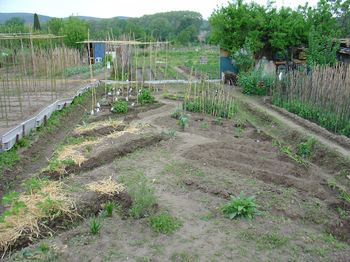
My kitchen garden on the 1st of May
Oddly, these May dates are the same from the Netherlands, way up in the Polar Circle, all the way down to Occitania. The cut-off town is Beziers, 100km from here, where its warmer and they have different days, different saints and they can grow meyer lemons outside. No cut-offs though.
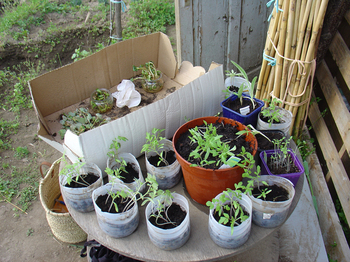
Tomato foetuses bracing themselves for a rigourous session of acclimatisation
I’m not having any of it, and even though it seems like Occitania lost a month of growing season this year due to the cooling effects of global warming, my sunflowers and lupines are growing visibly each day. But the men of the kitchen gardens are laughing at us Ladies-who-put-our-tomato-foetuses-out-early. Thursday, the gents will really split a gut watching me sow cantaloup, galia melon, cukes, luffah, gourds, pumpkins, spaghetti squash, courgette and watermelon into the bare naked ground. As a tribute to the Saints I’ll repurpose some plastic ice cream containers into little hot houses. See ya later Propagator.
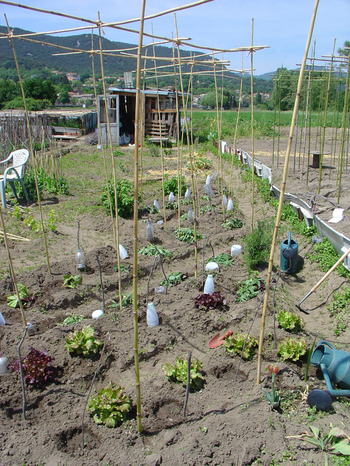
Lettuce and tomato section sorted
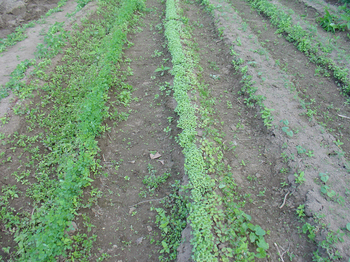
Covercrops before being plowed into seed beds
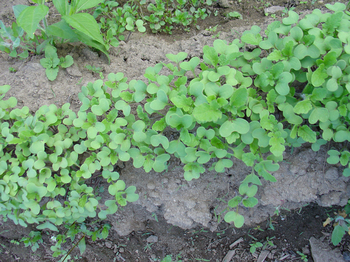
Mustard microsalad
- Dutch language Wikipedia article on Ice Saints
- English language snippet about Ice Saints. Odd, no Wikipedia article. Guess it’s up to me to at least translate for the free encyclopedia!
- Wikipedia (great article!) on Ice Saints in French. Just 100 kilometres from here there are different Ice Saints because the cut-off for night frost is two weeks earlier! Consolation for the fact that the folks living below Beziers can grow lemons is that they have a drier climate and don’t have clean river water flowing into their kitchen gardens.
debra at 13:49 | Comments (8) | post to del.icio.us
Street food waste = street food packaging
April 29, 2006
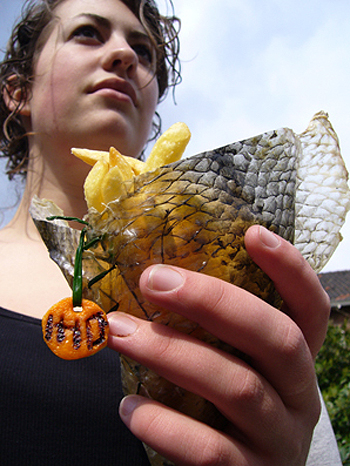
Fish and chips: image of street food packaging concept ‘IHO’, © Païvi Kovanen, Eva Arts and Caroline van Teeffelen 2006, used courtesy of the designers. Please respect student work, contact culiblog for updates.
(This is the second in a series of entries about the Street Food Workshop developed and conducted together with Katja Gruitjers for our students from the Design Academy Eindhoven and the HAS den Bosch.)
Just the simple fact of making street food creates tonnes of food waste. Students Païvi Kovanen, Eva Arts and Caroline van Teeffelen used food waste materials to develop packaging for street food. Katja and I were really impressed with their packaging concept IHO, which means skin in Finnish. Even mo’ bettah, when you turn the letters around to spell OHI, you get the Finnish word for leftovers.
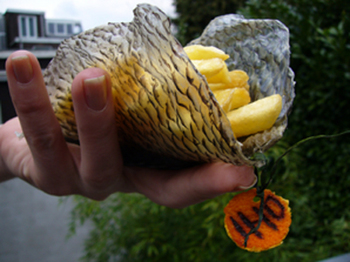
Image of street food packaging concept ‘IHO’, © Païvi Kovanen, Eva Arts and Caroline van Teeffelen 2006, used courtesy of the designers. Please respect student work, contact culiblog for updates.
The fish and chips sack is brilliant. Hand-sown dried fish skin imparts a nice fish aroma to the chips and you know how the Northern peoples love their (dried) fish. Katja and I are imagining a dusting of vinegar powder on the inside of the sack for a perfect flavour.
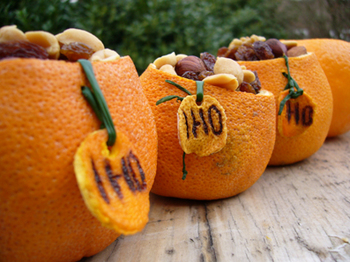
Image of street food packaging concept ‘IHO’, © Païvi Kovanen, Eva Arts and Caroline van Teeffelen 2006, used courtesy of the designers. Please respect student work, contact culiblog for updates.
Urban juice bars produce orange rind and pulp waste that is normally turned into silage to feed animals that us omnivores love to eat. Kovanen, Arts and van Teeffelen assured us that there’s plenty of rind and pulp to go around and they dried the rinds into snack containers. The pulp they turned most amazingly into a palm plate that has a wonderful hand feel to it.
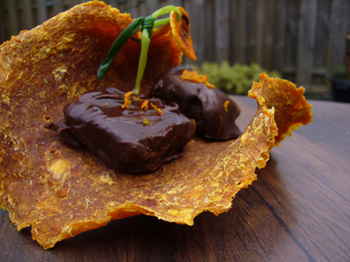
Image of street food packaging concept ‘IHO’, © Païvi Kovanen, Eva Arts and Caroline van Teeffelen 2006, used courtesy of the designers. Please respect student work, contact culiblog for updates.
As if this weren’t enough for one half-term street food assignment, the ladies Kovanen, Arts and van Teeffelen developed a new ceramic material produced from eggshells and potato starch and that can be formed into any possible shape. Here, the material has been formed into a palm plate.
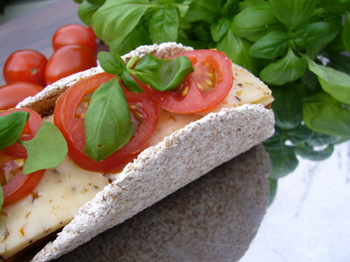
Fish and chips: image of street food packaging concept ‘IHO’, © Païvi Kovanen, Eva Arts and Caroline van Teeffelen 2006, used courtesy of the designers. Please respect student work, contact culiblog for updates.
IHO street food packaging concept by Kovanen, Arts and van Teeffelen.
debra at 11:06 | Comments (3) | post to del.icio.us


