



Street food collaborations: Streetberry!
April 24, 2006
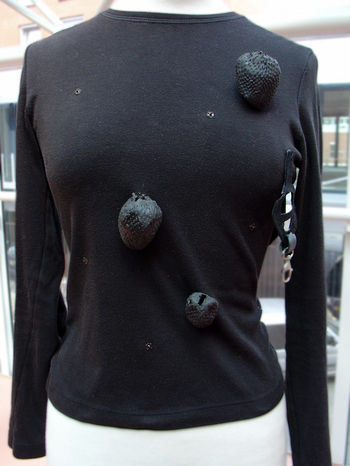
Streetberry design by Michou-Nanon de Bruyn, Milou Melis and Monica Ruiter. Please respect student work, contact culiblog for updates.
Nothing says wing-flapping like a subversive strawberry. Students Michou-Nanon de Bruyn, Milou Melis and Monica Ruiter have developed Streetberry as their final project for Katja Gruijters and my street food project. The collectible black rubber berries snap on to black t-shirts, rings, and necklaces made out of recycled bike tyres and representing the map of the city. The pieces smell like strawberries, but in a way that someone who is not a twenty-something woman can still appreciate.
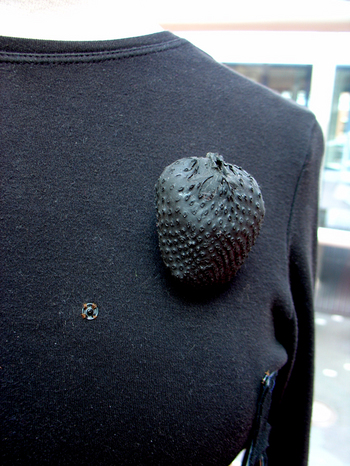
Streetberry design by Michou-Nanon de Bruyn, Milou Melis and Monica Ruiter. Please respect student work, contact culiblog for updates.
Since March, students from the HAS (Hoger Agrarische School, ‘s Hertogenbosch NL, Food Design) and the Design Academy Eindhoven (Atelier, Food) have been collaborating on a street food project that Katja Gruijters and I initiated. Last Friday they presented the conclusion to their R&D and in the next weeks I’ll show a few of the best projects here on culiblog. Katja and I are most pleased with the results and think that the collaboration proves that the Design Academy and the HAS should work together on food-related projects in the future.
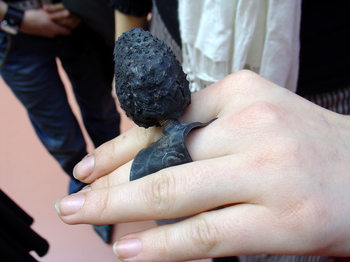
Streetberry design by Michou-Nanon de Bruyn, Milou Melis and Monica Ruiter. Please respect student work, contact culiblog for updates.
The assignment was to develop a a street food concept and in the course of 10 weeks develop this into a prototype. As you may already know, the NL is practically devoid of street food aside from the usual offerings of the Servex Group. Selling food on the street or at the train station is effectively illegal unless you are part of this horeca monopoly (HOtel, REstaurant, CAf̩ Рanother sexy Dutch acronym).
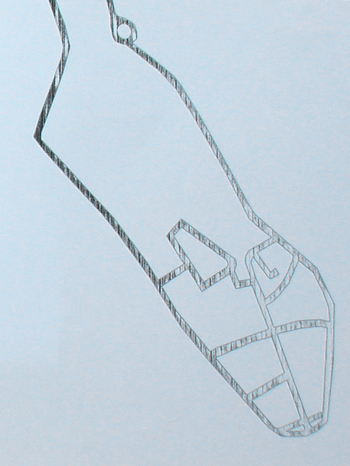
Streetberry design by Michou-Nanon de Bruyn, Milou Melis and Monica Ruiter. Please respect student work, contact culiblog for updates.
Katja and I wondered what future (food) and product designers, presented with a wealth of images and information about initiatives in other countries would come up with. Fortunately some students let their autonomous brains lead them away from the kitchen. A jewelry line based upon the map of the city, a new materials collection for street food packaging using the waste materials of commonly sold street food, and a conceptual art performance are some of the 12 fresh visions of what street food in the NL could become if it were allowed to flourish.

Streetberry design by Michou-Nanon de Bruyn, Milou Melis and Monica Ruiter. Please respect student work, contact culiblog for updates.
- Thank you Servex for convincing Dutch legislators that street food diversity is a hygiene issue!
- But seriously, thank you HAS for hosting this collaboration in your fabulous test kitchens!
- Thank you Design Academy Eindhoven (Kompas: Atelier) for being flexible and playful in terms of curriculum!
- Thank you Michou-Nanon de Bruyn, Milou Melis and Monica Ruiter for introducing us to Streetberry!
debra at 9:27 | Comments (0) | post to del.icio.us
Love difference,as in we love difference
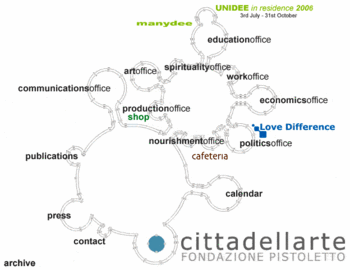
Of course the artistic movement for an intermediterranean politic is into food. And it sports a big fat Citta del Arte logo right on it’s homepage. Which led me to click on the Ministry of Nourishment link because I always wonder what folks mean by the word nourishment.
I’m none the wiser, but the Love Difference folks did done organise a Food Market Festival in which food markets (and their organisers) from around the world met this weekend in Turin. I wonder what they’ve got cookin’ for the next event, hopefully something megamaniacal. (Thank you, Julie Upmeyer, who sent this link on time.)
debra at 8:00 | Comments (0) | post to del.icio.us
Urban gardening lessons for Dutch children
April 21, 2006
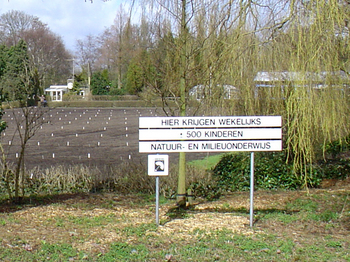
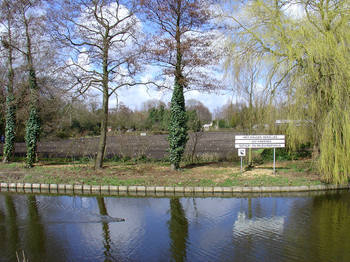
On an island in Amsterdam’s Westerpark, a horizontal grid of 1m2 garden plots are being prepared for the children. The sign says that around 500 children will receive weekly education about nature and the environment on these plots. Although this garden grid offers an extreme image of mini-allotments filled with one carrot, one lettuce, one rhubarb, one sunflower, one fennel, one this and one that, I cannot say that I think this is a negative idea in terms of education. In fact, gardening in this way has the potential to teach children about density and clustering. It’s like an MVRDV-isation of grammar school education. By this I am referring to educarion informed by architects MVRDV’s notions of density and as explored in their publications FARMAX (floor area ratio) and KM3, (cubic kilometer) Excursions on Capacities from Actar Publishers. Next step, vertical gardening for urban children!
(The image has been enhanced to increase readability of the sign.)
debra at 7:13 | Comments (6) | post to del.icio.us


