


Shorts in Bra
Slow Food on Film
April 15, 2006
And by shorts I mean short films. And by bra I mean Bra, Italy, where the short film festival, Corto in Bra will host a programme titled Slow Food on Film. How fine it is to see one’s sensibilities well represented, in a country that no longer has a vile mo fo as elected head of state.
As the Slow Food Movement’s spokesperson and founder Carlo Petrini promised at this year’s Berlinal Talent Campus, a number of short films at the BTC would be chosen and placed prominently within the Corto in Bra programme. This is great news, also because culiblog found quite a few of these films to be well worth watching. Nice to see my cinematic tastes reflected in the message of the Movement.
Although there’s nothing short about them, both the Future of Food, by Deborah Koons Garcia, and Taggert Siegel’s the Real Dirt on Farmer John will also be screened. Ms. Koons Garcia is the Slow Food on Film documentary jury chairperson and I’m pleased that this festival doesn’t even pretend to be non-partisan like the big film festivals do. Amen.
You can start brushing up your conversational Italian by downloading the Corto in Bra Film Festival programme here.
The culiblog selection from the Slow Food in Film programme is here:
-
Wednesday – 26.04.2006
– 22.45h
CONCORSO SLOW FOOD ON FILM DOC
LA VIDA DULCE / La vita dolce / Sweet Life di Rouven Rech
& Bettina Blimner (Cuba/ Germany, 2004, BetaSP, 15’, col.)
(also screening at 16.30h on Sunday 30.04.2006)
An almost slapstick documetary short about Cuban subsidised cake distribution. If you’re a Cuban mother on Mother’s Day, you will get yer dang cake. After watching the short several times, it still confounds me that even though cake boxes are used in the transport of these generously frosted creations, no one puts the cake in the box, preferring instead to keep it on display, exposing the cake to all manner of dangers. Hilarious and sweet. - Thursday – 27.04.2006
– 21.00h
DOÑA ANA / La signora Ana / Mrs. Ana
di Marlon Vasquez (Colombia, 2004, DV, 1’44’’, col.)
(Incontro con gli autori / Meet the directors)
(also titled STRAWBERRY EATING WOMAN) Marlon Vasquez Silva, Colombia: This was by far the most unique film of the BTC, an animation comprised of beautifully created watercolours and collages addressing the plight of displaced farmers in Colombia. Without being overtly political, Strawberry Eating Woman lays bare the loss of cultural capital that occurs when small agricultural communities are destroyed. Surprising and refreshing, like an excellent little strawberry.– 21.45h
THE FUTURE OF FOOD / Il futuro del cibo
di Deborah Koons Garcia (U.S.A., 2004, Beta SP, 90’, col.) - Friday – 28.04.2006
– 21.00h
THE REAL DIRT ON FARMER JOHN / La sporca verità sul
contadino John di Taggart Siegel (USA, 2005, DV/Super8, 58’, col.)
(also screening at 16.30h on Saturday, 29.04)– 23.00h
LE PRIX D’UN PLAT / Il costo di una cena
The Cost of Dinner di Malam Saguirou (Nigeria)
– Incontro con gli autori / Meet the directors - Saturday – 29.04.2006
– 21.45h
CONCORSO SLOW FOOD ON FILM DOC
THE SOUP PEDDLER / Il venditore ambulante di zuppe
di Lisa Kaselak (USA, 2005, DV, 30’, col.)
I have not seen this film, but I am curious. - Sunday – 30.04.2006
– 22.30h
LA VENDEMMIA / The Grape Harvest
di Esther Koohan Paik (USA, 2006, DV, 21’, col.)
I have not seen this film, but I am curious.– 22.50h
MALENKAYA KATERINA / La piccola Katerina /
Tiny Katerina di Ivan Golovnev (Russian Federation, 2004, DV, 5’, col.)
(also screening Monday at 12.30h)
TINY KATERINA. Ivan Golovnev, Russian Federation: Golonev admits readily that Tiny Katerina is a film about changing lifestyle more than about food. It documents the youngest member of a Northwest Siberian family that lives in a felt tent in near isolation. Katerina can’t be more than two years old, but it is confusing whether she is playing at being an adult or is actually participating in the rigourous family chores! We see her lugging blocks of firewood around and cooking for the family’s dogs. Two years old! Golovnev’s camera is completely unobserved, offering an intimate view of a life that will soon vanish in the petrol politics currently plaguing this region. The documentary short has a distrubing ending that places the film within a larger political context.
- Short Film Festival in Bra, english language website
- Slow Food on Film in Bra
- Wikipedia on the Slow Food Movement
- culiblog film review of the Real Dirt on Farmer John and the ‘green’ programming of the 2005 IDFA
- culiblog film reviews of the 2006 Berlinale Talent Campus short films
- The Future of Food by Deborah Koons Garcia
By the way, the festival passes are a bargain, so you can really forcus on enjoying this ‘citta slow’, which is ironically pronounced cheetah slow.
debra at 12:26 | Comments (0) | post to del.icio.us
Lace, about faceAnder Kant
April 6, 2006
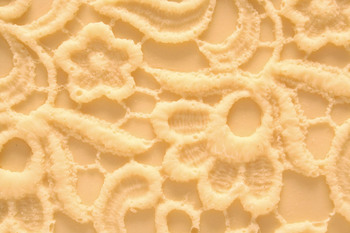
Image of white chocolate lace detail, by Katja Gruijters, courtesy of the designer
Aren’t these edible lace tiles by food designer Katja Gruijters exquisite? She makes them out of caramel, white and milk chocolate and sand tart. They feature prominently in an exhibition on contemporary lace design titled, ‘Ander Kant’, (literally ‘other lace’, or ‘other side’) at the Boijmans van Beuningen Museum in Rotterdam.
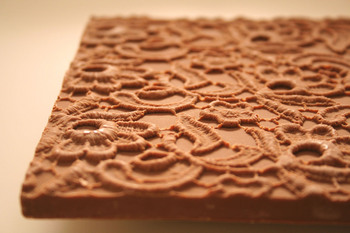
Image of a milk chocolate tile, by Katja Gruijters, courtesy of the designer
The collection is on sale at the Boijmans van Beuningen Museum shop but you can also find out more about them at Katja’s website.
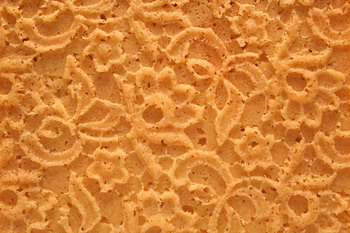
Image of a sand tart tile, by Katja Gruijters, courtesy of the designer
- Katja Gruijters, food designer
- Ander Kant/Other Lace at the Boijmans van Beuningen Museum, Rotterdam until April 30, 2006
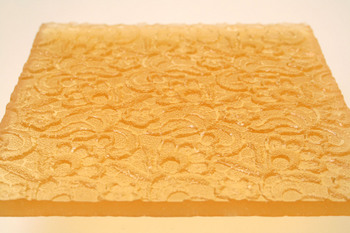
image of a caramel tile, © Katja Gruijters, courtesy of the designer
(Please read more… )
debra at 1:47 | Comments (4) | post to del.icio.us
Will swap saliva for a home, the problem with bird nest soup
April 4, 2006
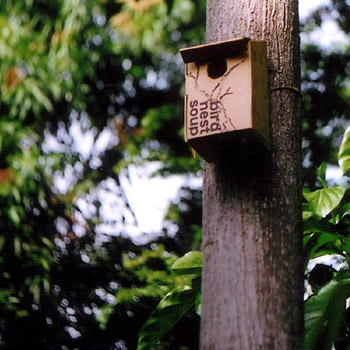
image from Hoko Studio design collaborative, cropped and used entirely without permission
If you were a bird living in a cave in Thailand, would you rather
1. live in a house of your own making constructed from spit and twigs?
or
2. live in a gifted house made out of recycled cardboard?
Bad question. Here comes a better one.
If your house was under threat of confiscation, would you rather
1. be given a house built out of recycled cardboard?
or
2. be left to your own devices to emotionalise enough angry bile and spit to produce a new casa de saliva?
It may be yesterday’s news to some, but I was surprised to read that swiftlets are suffering forced eviction due to gourmand greed! Swiftlets are the little birds whose nests are prized for bird nest soup. Some varieties of Thai swiftlet construct nests comprised of 80% lugie! Homelessness seems like a poor reward for resourcefullness.

image from Hoko Studio design collaborative, cropped and used entirely without permission
Design collaborative Hoko Studio has a partial solution. And by ‘partial’, I mean partial. Use birdhouses to package and distribute the nests. When the cook is done leaching the saliva out of the nest, the customer can hang the packaging on a tree (or high up in a cave in Thailand) and commence slurping with a partially clean conscience!
Partial solutions are only half the beauty of critical design.
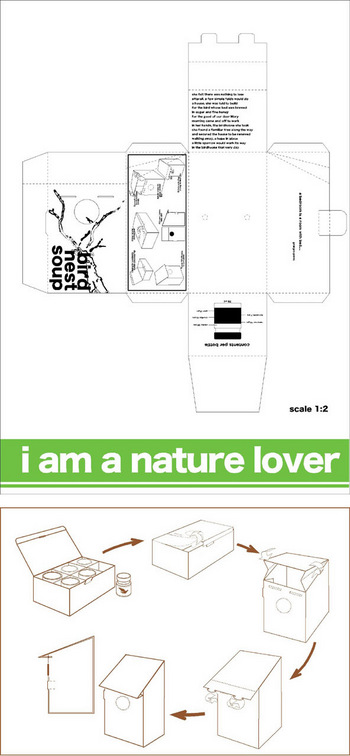
image from Hoko Studio design collaborative, cropped and used entirely without permission
- Know your bird nest
- Know your birds’ nests even more
- Hoko Studio’s ‘Eat Bed’ bird nest proposal at Platform 21
- Meet Hoko Studio Design Collaborative, the designers of ‘Eat Bed’
- Wikipedia bird’s nest soup page with a cool picture of a saliva nest
Hoko Studio’s proposal titled ‘Eat Bed’ is one of several ‘critical design’ projects exhibited at the Platform 21 website under the title, Positive Alarm (fixing what is wrong without making it wronger). Platform 21 is a newish venue for design situated in Amsterdam’s newish city center, de Zuidas, (pronounced South Central).
Here’s the Platform 21 culture blurb: ‘the domain of creation is not something professionals have a monopoly on. We are interested in creative developments in fashion and design, including amateur initiatives.’
Huh. Platform 21 does seem like an OK initiative, although their website is probably the most annoying surf you’ll have this week. Indeed a platform for Dutch and international design initiatives has been sorely missing ever since the nest known as the Vormgevings Instituut (pronounced Netherlands Design Institute) was confiscated by barbaric xenophobes back in the ’90’s. Maybe Platform 21 will provide a new place for design to alight. The director is ethnic Dutch, always a good starting point. Soup is on!
- Hoko Studio’s ‘Eat Bed’
- Platform 21 a design nest in Amsterdam’s Zuidas
- Platform 21’s online exhibition Positive Alarm
debra at 20:58 | Comments (0) | post to del.icio.us


