

A midsummer garden dinner at Marlein’s
June 20, 2006
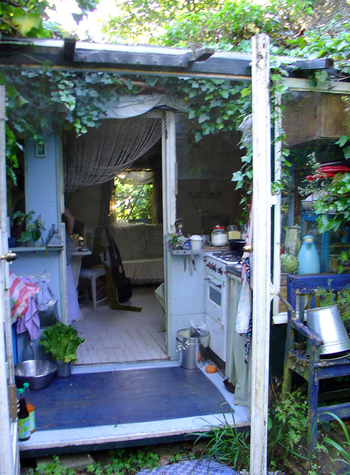
Marlein’s tuinhuis rhymes with town house but means garden house or cottage
On an island between the Amsterdam-Rhine Canal and the IJ inland shipping lands, sandwiched between harbours, dubious car re-painting garages and tucked under a freeway flyover, there is a hidden paradise that I was totally unaware existed until last Saturday, when Marlein invited me to dinner at her garden house. It hadn’t occured to me that in the midst of all this bustle and crud that there could be a place of such lush beauty and serenity, a place where nature takes over and you can’t imagine or even glimpse anything but the burgeoning surrounds that envelop you.
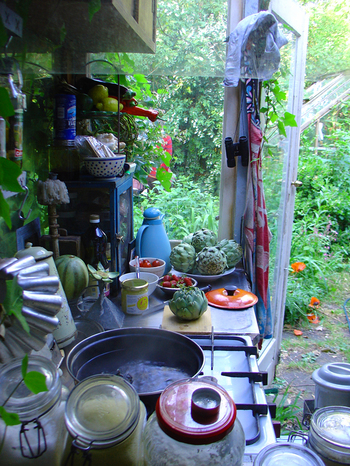
View from inside the indoor-outdoor kitchen to the front garden
Marlein, Joost and I lazily drank mint tea with saffron sugar crystals, chitchatting, enjoying the evening light. Magically Marlein produced dinner and we supped on greens and succulent things, sort of lowish on the food chain.
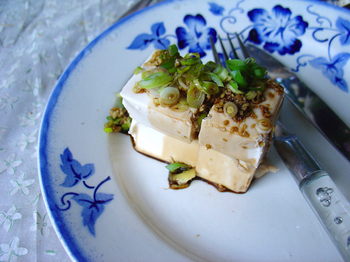
Silken tofu with spring onions and drizzled with nama shoyu is an elegant start to our dinner
It stays light until almost eleven!
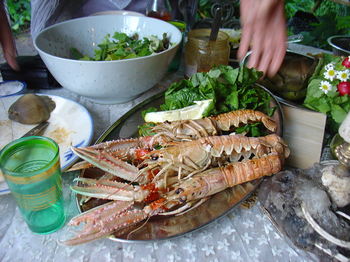
When the water insects arrived, we sucked them inside out.
And when it got too dark and a little bit chilly, we retired to the great indoors for a dessert of elder flower tempura dusted with powdered sugar, chocolate, dates and Pakistani burfi.
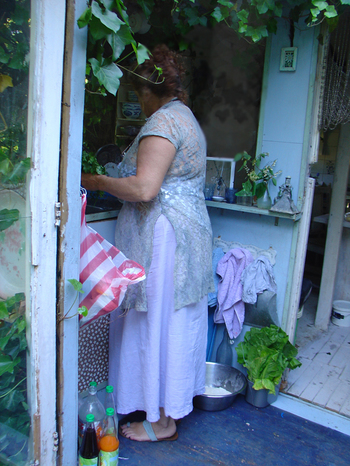
This sort of garden house is typical of the Dutch style allotments, although usually these locations have long socialist histories and are highly regulated, Marlein’s garden is in a non-sanctioned area, and unfortunately one that will be devoured by a land development project starting in 2008. Pick your battles, there two full summers to enjoy before Marlein and her garden neighbours find the next fabulous and secret place.
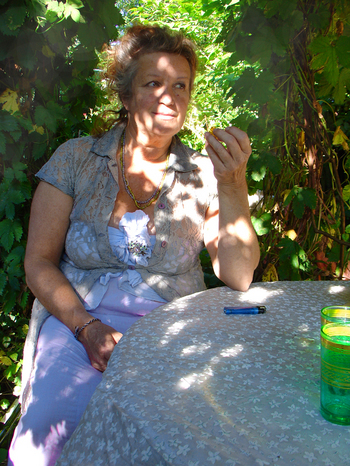
Lady Marlein
debra at 13:24 | No comments | post to del.icio.us
Spring cabbage and
cashew cheese terrine,
not just (but also) for
raw food freaks,
vegans and hippies
June 17, 2006
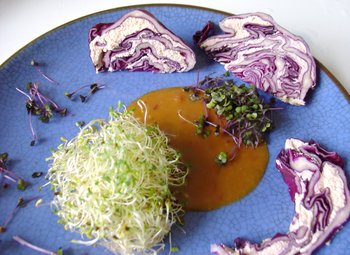
Not counting nut loaf and enema, does an uglier word exist than cashew cheese? Overexposure to Cheech and Chong while growing up has affected my sensibilities such that I can’t even hear the word loaf without chuckling silently like an eleven year old. And the word cashew cheese makes me think of all the cheeses we produce with our very own bodies. I know, I’m immature. Still.
The cashew hummus recipe (mo better?) I’m working on is finally getting really cheeesy thanks to the discovery that you can ferment anything if you just forget about it long enough. Last batch I let the cashews grow a sentient microbial film that was capable of speaking short sentences in Esperanto. Then I rinsed them, (tasted them to see if they were palatable, kaj lo kaj rigard and turned them into… cheese. That’s what you get for learning Esperanto. Cashew fromaÄo estas ni! (Cashew cheese is us!)
Cut the cabbage in half, remove the core (and toss that into the chipper-shredder that is my mouth), spread layers of the cashew in between the leaves, put the cabbage back together, smoosh and slice. My kind of recipe. Are young cabbages looser than old cabbages? Are cabbages like me? Look for a ‘loose’ cabbage.
The puddle is a dressing made with miso, sesame oil, rice wine vinegar, sambal djeroek and a dash of maple syrup. Not a local ingredient in the lot, though I’m preparing for a career in miso making when I’m in my 80’s to compensate. Seriously. And now, this same entry in Esperanto!
(Please read more… )
debra at 17:10 | No comments | post to del.icio.us
Let farmers be bygones
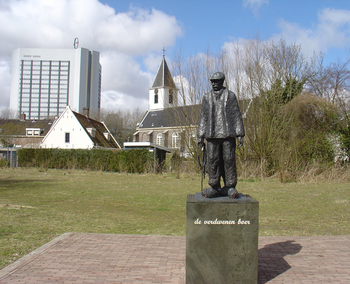
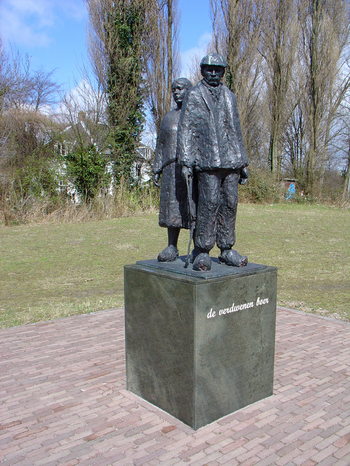
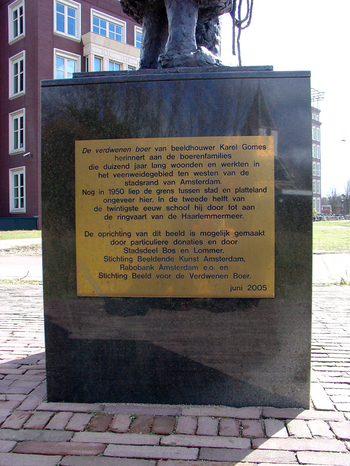
Let bygones be farmers? On the other side of my neighbourhood park there is a monument in honour of the ‘lost farmer’, farmers lost to change. The text on the back of the pedestal says, The Bygone Farmer by artist Henk Gomes commemorates the farmers that for thousands of years lived and worked in the fens to the west of Amsterdam’s city limits. Until the 1950’s this was the border between city and the country. In the 2nd half of the 20th century this border was pushed back to the peripheral waterway beyond the Haarlemmermeer.
The placement of this statue has been made possible by funding from private donations and with donations from the Amsterdam borrough of Bos en Lommer, the Amsterdam Foundation for Visual Arts, the Amsterdam Rabobank and also the Foundation for the Bygone Farmer.
The task of translating the Dutch verb verdwenen has been preventing me from writing this entry since I took these pictures back in April. Verdwenen can mean a lot of things, and none of which sound particularly as poetic in English as Verdwenen Boer does in Dutch.
Lost,
extinct,
vanished,
disappeared.
They used to be here.
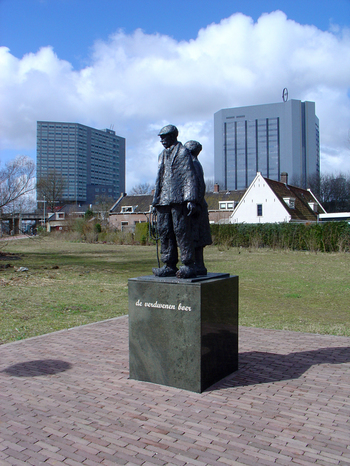
Nice that the artist included the boerin in the actual sculpture, although he left her out of the title. In Dutch, the female farmer has her own word. Maybe Gomes was using the term boer as a general term.
Speaking of Dutch public art commissions, check out the iron line drawing on top of the tax building.
debra at 6:48 | No comments | post to del.icio.us


